Product line
Point of Purchase Display: The Complete B2B Guide to Specifying POP Displays That Sell
A point of purchase display is the last three feet of your marketing budget — the physical structure that turns a shopper's glance into a pick-up, and a pick-up into a sale. For brand owners, retail buyers, and distributors sourcing from Asia, the difference between a display that performs and one that gets recycled is decided long before production: in material choice, structural engineering, and how well the unit survives the retail environment. This guide covers what POP displays are, how they differ from POS, the main display types, and how to specify them so your investment reaches the shelf intact and sells.
POP vs POS: What's the Difference?
The terms are often used interchangeably, but there is a practical distinction. Point of purchase (POP) generally refers to promotional display units placed anywhere in or near the purchase environment — aisles, entrances, checkout zones — designed to attract attention and drive impulse consideration. Point of sale (POS) typically describes the immediate transactional zone: the checkout counter, register queue, and the countertop displays and fixtures within arm's reach of payment.
In sourcing terms, the difference matters for structure. A POS counter unit must be compact, stable on a small footprint, and often security-conscious. A POP floor display can be larger, heavier, and built for volume. Shenzhen Store Display Tech Inc. manufactures both, across cardboard, acrylic, and permanent-material constructions, so the specification conversation starts with where the unit will live — not with what we prefer to build.
The Main Display Types You Can Source
Most retail programs are built from a small set of proven formats. Choosing the right one early keeps tooling, freight, and assembly costs predictable.
- Floor display stands — Free-standing units, commonly corrugated cardboard, placed in aisles or on open floor. High capacity, strong branding surface.
- Counter display stands — Compact units for checkout counters and service desks. Acrylic and PVC foam board are common where durability and a premium look matter.
- Pallet displays (PDQ / full pallet) — Product shipped and merchandised on its own pallet, often with a printed pallet skirt. Ideal for high-volume promotions and club-format retail.
- Endcap displays — Built for the end of an aisle, combining shelf structure with back-panel branding.
- Hook and pegboard racks — For hanging SKUs; metal, wood, or composite construction depending on load and lifespan.
- Smart interactive displays — Acrylic or permanent units integrating an LCD screen with audio/video playback, used where product education or demo content lifts conversion.
Material Selection: Cardboard vs Permanent Materials
The single biggest cost and performance decision is whether your display is disposable or permanent. Both are legitimate; they solve different problems.
Corrugated cardboard is the workhorse of short-cycle promotions. It is light, prints edge-to-edge with high-impact graphics, ships flat, and is recyclable. It suits seasonal campaigns, new-product launches, and any program where the display's life is measured in weeks. Standard formats include corrugated floor display stands, paper display shelves, PDQ pallet displays, and paper pallet skirts.
Permanent materials — acrylic, PVC foam board, stainless steel, iron and wood — carry a higher unit cost but survive repeated replenishment and multiple retail cycles. Acrylic counter display stands and desktop units deliver a clean, premium finish; steel and wood structures handle heavy loads in high-traffic locations. For brands running a rolling in-store presence rather than a single campaign, permanent fixtures usually win on cost per selling day.
If your program includes electronics, an anti-theft counter display for wearables or an L-shaped smart desktop unit with LED lighting may be the right frame — these are engineered for security and powered merchandising, not just presentation.
Specification Table: Typical Ranges
The table below reflects standard manufacturing ranges. Exact figures depend on structure, print coverage, and finishing.
| Parameter | Typical Options / Range |
|---|---|
| Size | Custom, built to your retail footprint and SKU dimensions |
| MOQ | Paper POP displays: 50–100 sets/pieces; smart displays: 100 units |
| Lead time | Custom cardboard displays: 10–15 days; smart displays: 20–30 days |
| Full-color litho-lamination, flexo, or digital depending on run |
Certificates are available upon request. As a National High-Tech Enterprise (recognized 2016), we operate under ISO9001, Sedex-4P, FSC, Disney audit, and Costco certification programs.
The Structural Design Process
Good POP displays are engineered, not illustrated. Our process runs from brief to dieline in four stages:
- 1. Brief and load analysis — Product weight, dimensions, quantity per display, and the retail environment determine the structural concept.
- 2. Concept and 3D modeling — Layout, shelf pitch, and branding zones are modeled before any cutting.
- 3. Structural design and dieline — The unit is engineered for flat-ship assembly, stacking strength, and print registration.
- 4. Prototype and validation — A physical sample is produced for fit, load, and assembly testing before tooling.
- Build to the dieline — never scale artwork to fit after the fact.
- Keep critical brand elements inside safe zones; allow for fold and bleed.
- Use vector logos and 300 dpi raster images at final size.
- Provide a layered file with Pantone references if color accuracy is contractual.
- Account for shelf edges, product cut-outs, and assembly flap positions.
This is where most sourcing problems are prevented: a display that assembles quickly on a retail floor, and still holds its shape after a week of handling, was designed that way.
Artwork Guidelines for Retail-Ready Displays
Supply artwork that survives the dieline. Practical rules:
Our team reviews artwork against the dieline before print, so registration and trimming issues are caught at the file stage, not on the production line.
Measuring In-Store Impact
A display's job is measurable: sell-through rate, units per display per week, replenishment frequency, and shrinkage. Before you brief a supplier, define the metric. A high-capacity floor display optimized for sell-through will be specified differently from a counter unit designed to trigger trial at the register. Build the measurement plan into the brief, and structural decisions follow.
Sourcing POP Displays From a Manufacturer
Shenzhen Store Display Tech Inc. has manufactured custom display fixtures since 2003, with production in Shenzhen and offices in Hong Kong, Japan, Australia, and the United States. We offer custom point of purchase display programs across cardboard, acrylic, and permanent materials, plus co-packing and retail-ready packaging services. MOQs start at 50–100 sets for paper displays, so pilot programs are practical before a full rollout.
Get Free Structural Design — send us your product dimensions, target retail environment, and campaign timeline, and our engineering team will return a structural concept and dieline for review. You can also Request a Display Sample to validate assembly and load, or Get Dieline & Quote to move straight into costing. Email [email protected] to start.
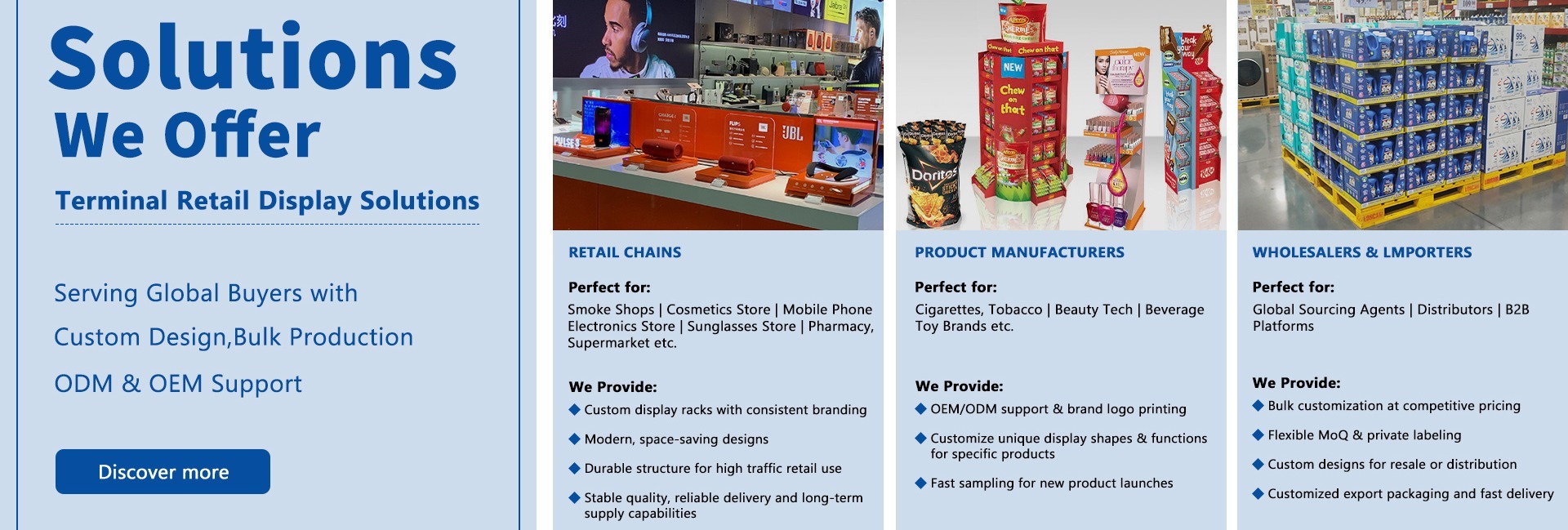
Shown: company production samples. Artwork and structure fully customizable.
Get a free dieline for your product
Send dimensions and artwork — our engineers return a structural design within 48 hours.
Get Dieline & Quote